


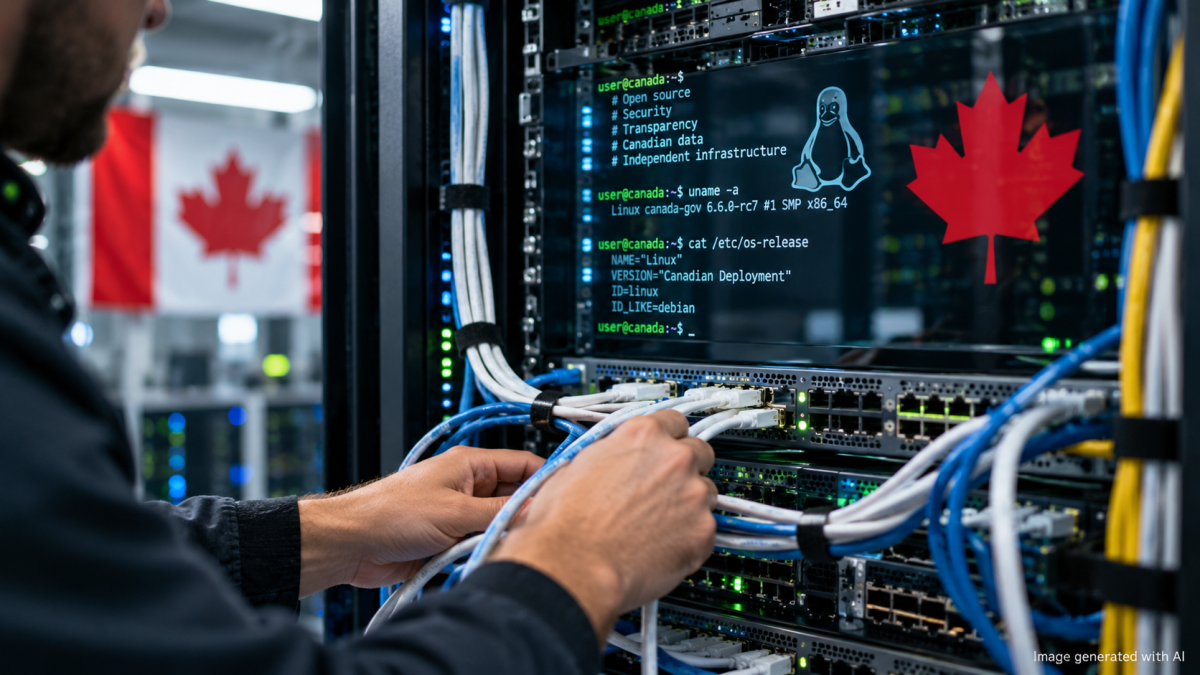
Digital sovereignty is rapidly moving from a policy discussion to a strategic priority.
Governments are asking increasingly important questions: Who controls our data? Where is our critical digital infrastructure located? Under whose laws does it operate? What happens if access to a foreign technology provider is interrupted, restricted or becomes politically complicated?
But there is another question that deserves just as much attention:
Who controls the software that makes our digital infrastructure work?
Across Europe, governments are beginning to answer that question by placing open source at the centre of their digital sovereignty strategies.
Canada should be paying attention.
Europe Connects Open Source and Sovereignty
The European Union's new Open Source Strategy places open-source technology directly within Europe's broader technological sovereignty agenda.
The objective goes far beyond reducing software licensing costs.
The European Commission identifies open source as a way to reduce dependency on non-European technologies, increase control over critical digital infrastructure, strengthen transparency and security, encourage competition, and create sustainable European technology ecosystems.
The strategy specifically identifies areas including operating systems, cloud infrastructure, artificial intelligence, cybersecurity and workplace technologies as priorities for open-source development and investment.
That distinction matters.
Europe is increasingly treating open source not simply as a software-development model, but as strategic digital infrastructure.
The European Commission's Open Source Observatory reinforced that direction during a September 24 webinar on open source in public administration. Representatives discussed procurement reform, open standards, Open Source Programme Offices, verified software repositories, training and the need to build the skills required to operate open technologies.
Vendor lock-in and knowledge gaps were identified as significant barriers.
The response is not to abandon technology developed elsewhere or attempt complete technological isolation. It is to build the capability to operate critical systems without being entirely dependent on a single supplier.
That is what meaningful digital sovereignty looks like.
Canada Is Asking Many of the Same Questions
Canada is not ignoring digital sovereignty.
The Government of Canada now defines digital sovereignty as its ability to exercise autonomy over digital infrastructure, data and intellectual property and to make independent decisions about digital assets regardless of where technologies are developed, hosted or supported.
Importantly, Canada's framework recognizes that digital sovereignty extends beyond the physical location of data.
It includes operational resilience, supply chains, workforce capability, interoperability, institutional control and the ability to continue operating critical systems.
The framework also acknowledges the risks associated with reliance on proprietary technologies.
It specifically identifies future consideration of vendor-neutral formats and government-controlled environments and states that the Government of Canada will examine how open-source solutions can support service delivery, transparency, interoperability and continuity of operations.
That is an important acknowledgement.
But acknowledgement must eventually become implementation.
A Canadian Data Centre Is Not Enough
Canada has understandably focused considerable attention on data residency, cloud sovereignty and domestic computing infrastructure.
Those investments matter.
A new example arrived this week in Québec.
At Convergence 2026 in Québec City, Canadian technology company Micrologic announced its Canadian Sovereign Digital Vault, designed to maintain protected copies of organizational data in Canada under Canadian jurisdiction.
Projects like this strengthen Canada's domestic digital infrastructure and improve resilience.
But infrastructure sovereignty alone does not create complete digital sovereignty.
A server can physically sit in Canada.
The data stored on it can remain under Canadian jurisdiction.
The electricity powering it can come from a Canadian utility.
Yet the operating system, cloud management platform, authentication infrastructure, productivity software and other critical components may still depend on technologies controlled by foreign vendors.
Where technology is hosted matters. Who can understand, maintain, modify and operate that technology matters too.
This is where open source becomes strategically important.
Open Source Creates Options
Open source does not automatically create sovereignty.
Simply downloading source code does not suddenly make a government independent.
Software still needs to be maintained. Security vulnerabilities need to be addressed. Infrastructure must be operated. Projects need sustainable governance. Organizations need people with the skills required to deploy and support the technology.
But open source provides something strategically valuable:
options.
Open standards and open-source software can make it easier to move between suppliers, audit technology, maintain systems internally, build domestic expertise and avoid situations where a single vendor controls an essential component of government infrastructure.
That does not mean every proprietary system should be replaced.
Digital sovereignty should not become an ideological contest between proprietary and open-source software.
Government should use the technology that best serves Canadians.
But when two technologies can perform the same function, factors such as interoperability, vendor independence, long-term maintainability, domestic capability and technological sovereignty should become part of the procurement decision.
Public procurement is one of the most powerful tools governments possess to shape technology ecosystems.
Europe increasingly recognizes that.
Canada should as well.
Sovereignty Requires People
There is another part of this discussion that is sometimes overlooked.
Digital sovereignty cannot simply be purchased.
It requires people.
A country cannot meaningfully control digital infrastructure if it does not have enough people capable of operating it.
Linux system administrators, cybersecurity professionals, DevOps engineers, cloud specialists, infrastructure engineers, software developers, automation specialists and open-source contributors all form part of the human infrastructure behind digital sovereignty.
If Canada wants greater control over its digital future, Canada must also invest in the workforce capable of building and maintaining that future.
That means education.
It means training.
It means creating pathways into open technology careers.
It means giving students, workers and organizations opportunities to develop practical experience with Linux and open-source infrastructure.
And it means supporting the Canadian communities and organizations already developing that expertise.
Software sovereignty without skills sovereignty is incomplete.
Canada Needs a National Open Source Strategy
Canada does not need to copy Europe.
We have our own governments, technology sector, regulatory environment and economic realities.
But Canada can learn from what Europe is doing.
A Canadian approach could begin with several practical principles:
- Establish a national open-source strategy for the federal public sector.
- Require open-source alternatives to receive meaningful consideration in appropriate technology procurement.
- Expand the use of open standards and vendor-neutral data formats.
- Identify critical areas of government infrastructure where excessive dependency on a single supplier creates strategic risk.
- Establish or strengthen Open Source Programme Offices within government.
- Create trusted repositories and security frameworks for public-sector open-source software.
- Encourage government-developed software to be released as open source when security, privacy and operational requirements permit.
- Invest in Canadian Linux, cybersecurity, cloud, DevOps and open-source workforce development.
- Support Canadian companies and organizations that provide open-source services, infrastructure and expertise.
- Cooperate internationally with trusted partners developing open digital infrastructure.
None of this requires Canada to isolate itself technologically.
Quite the opposite.
Open source is built around international cooperation.
Digital sovereignty does not mean building a digital wall around Canada. It means ensuring that Canada retains meaningful control, capability and choice within an interconnected world.
The Question Is Not Whether Canada Uses Foreign Technology
Canada always will.
So will Europe.
Modern technology supply chains are global, complex and deeply interconnected. Complete technological autonomy is neither realistic nor necessarily desirable.
The more useful question is:
Could Canada continue operating critical digital services if its relationship with a major technology supplier changed?
Could another Canadian organization maintain the system?
Could government move the data?
Could another provider operate the infrastructure?
Could Canadian engineers understand and modify the software?
Could essential services continue?
Those are sovereignty questions.
And open-source technology can provide part of the answer.
Canada's Digital Future Should Include Open Source
Canada has already started the digital sovereignty conversation.
Now we need to broaden it.
Canadian data centres are important.
Canadian cloud infrastructure is important.
Canadian jurisdiction is important.
But sovereignty cannot stop at the walls of the data centre.
It must extend into the software, standards, skills and knowledge that make those systems function.
Europe is increasingly recognizing open source as a strategic component of technological sovereignty.
Canada should do the same.
Not because open source is automatically better.
Not because proprietary technology should disappear.
But because a sovereign country should always preserve the ability to understand, operate, secure and ultimately control the digital infrastructure on which it depends.
Digital sovereignty is not simply about where our technology runs.
It is about whether we retain the knowledge, capability and freedom to run it ourselves.
Linux Association of Canada
Comments (0)