


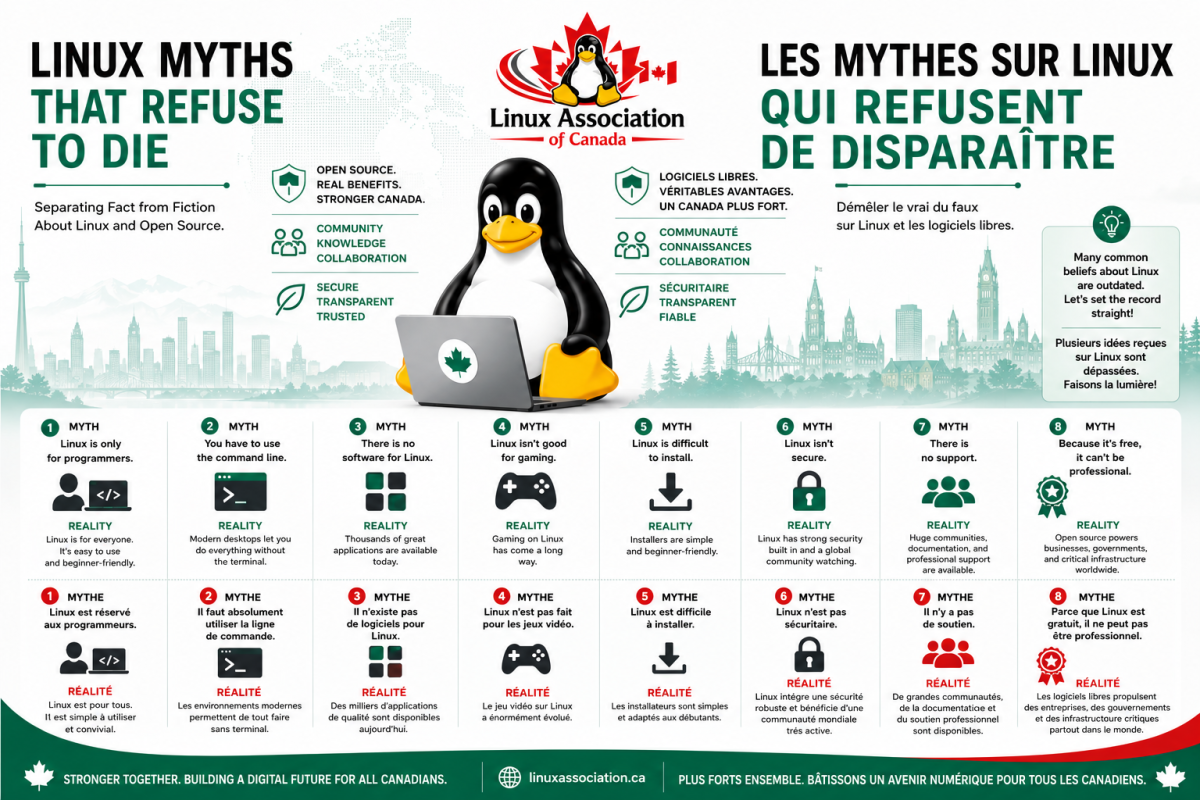
Separating Fact from Fiction About Linux and Open Source
For many Canadians, Linux remains something of a mystery. Some see it as an operating system reserved for programmers and cybersecurity experts, while others assume it is difficult to use or incompatible with everyday computing.
The reality is very different.
Linux powers much of the modern digital world. It runs the majority of the internet, most of the world's supercomputers, countless cloud platforms, and millions of smartphones through Android. Yet many misconceptions from decades ago continue to discourage people from giving Linux a chance.
Let's examine some of the most common myths—and the facts behind them.
Myth #1: Linux Is Only for Programmers
Perhaps the most persistent misconception is that Linux is only suitable for software developers or highly technical users.
While Linux certainly provides powerful tools for programmers, modern Linux distributions are designed for everyone. Most everyday tasks—browsing the web, sending email, editing documents, watching videos, online banking, video conferencing, and managing photos—are performed through intuitive graphical applications.
Many people use Linux every day without ever opening a terminal window.
Myth #2: You Have to Use the Command Line
The command line is one of Linux's greatest strengths, but it is not a requirement.
Popular desktop environments such as KDE Plasma, GNOME, Cinnamon, and Xfce provide complete graphical interfaces that allow users to manage files, install software, configure printers, connect to Wi-Fi, and customize their systems without typing a single command.
The terminal remains available for those who enjoy using it, but it is entirely optional for most users.
Myth #3: Linux Has No Software
This may have been true many years ago, but today Linux offers thousands of high-quality applications.
Popular software includes:
- Firefox and Chromium
- LibreOffice
- Thunderbird
- GIMP
- Inkscape
- Blender
- VLC Media Player
- OBS Studio
- Krita
- Audacity
- Kdenlive
Many commercial applications are also available, and web-based services such as Microsoft 365, Google Workspace, Zoom, Slack, and Discord work perfectly through modern web browsers.
Myth #4: Linux Isn't Good for Gaming
Gaming on Linux has changed dramatically over the past several years.
Valve's Steam platform, together with Proton, allows thousands of Windows games to run on Linux with little or no configuration. The popularity of the Steam Deck has also accelerated Linux gaming development across the industry.
While not every game is available, Linux gaming is no longer a niche hobby—it has become a practical option for many players.
Myth #5: Linux Is Difficult to Install
Modern Linux installers have become remarkably user-friendly.
Many distributions provide guided installation processes that are no more difficult than installing Windows. Some can even be tested directly from a USB drive before making any changes to your computer.
For users with older computers, Linux can often breathe new life into hardware that struggles with newer proprietary operating systems.
Myth #6: Linux Isn't Secure
No operating system is completely immune from security threats.
However, Linux has earned a strong reputation for security due to its architecture, open development model, rapid security updates, and permission system.
Because the source code is openly available, security researchers around the world can review, audit, and improve it continuously.
Good security practices remain essential regardless of which operating system you use.
Myth #7: There Is No Support
Linux has one of the largest technology communities in the world.
Support is available through:
- Community forums
- Documentation projects
- Linux User Groups
- Online communities
- Professional support providers
- Commercial Linux vendors
In Canada, the Linux Association of Canada is working to strengthen this support network by connecting communities, promoting education, supporting local Linux User Groups, and developing practical learning resources for users of all experience levels.
Myth #8: Linux Is Free, So It Can't Be Professional
Open source software is developed using professional engineering practices by individuals, universities, governments, non-profit organizations, and some of the world's largest technology companies.
Major organizations including banks, research institutions, cloud providers, telecommunications companies, and governments rely on Linux every day to operate critical infrastructure.
The fact that software is open source says nothing about its quality—it simply means that users have the freedom to study, use, modify, and share it under the terms of its licence.
The Bottom Line
Many of today's assumptions about Linux are based on experiences from twenty years ago.
Modern Linux is stable, polished, secure, and accessible. Whether you are a student, educator, retiree, business owner, software developer, or simply someone looking for an alternative operating system, there has never been a better time to explore what Linux has to offer.
Technology should empower people—not limit them. By making open source software more accessible, we help build a stronger, more digitally resilient Canada.
If you've never tried Linux before, consider downloading a beginner-friendly distribution and exploring it from a live USB drive. You may discover that many of the myths you've heard simply no longer reflect reality.
Comments (0)