


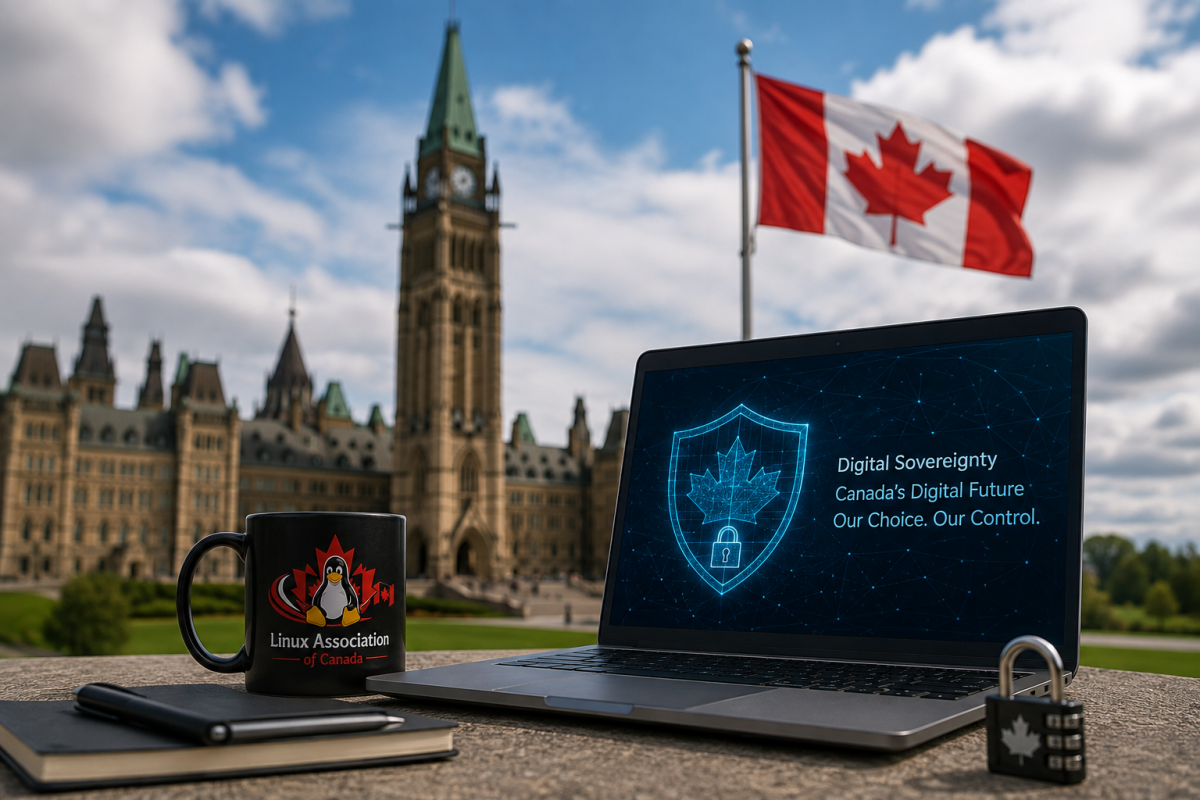
Canada has been talking about sovereignty for a long time, in terms of borders, natural resources, defence, telecommunications and economic independence. But there is a different form of sovereignty which is increasingly important - digital sovereignty.
Every day, Canadians use digital technology to communicate, to work, to study, to access government services, to run businesses, and to store personal information. Governments use digital technology. Schools do too. Businesses are dependent on it.
The question is no longer whether Canada is dependent on digital technology - the question is whether Canada has any choice in the technology it uses. That is the real issue with digital sovereignty.
What is digital sovereignty?
Digital sovereignty is the ability to maintain control over our digital infrastructure, our data, and our options.
It does not mean that we have to insulate Canada from the rest of the world, or that all of our software and cloud services have to be home-grown.
- It is about choice, and it is about having options.
- Can we move our data elsewhere?
- Can we look inside the technology we are using?
- Can we change?
- Do we know where our data is?
- Can our systems continue to operate if the technology we are using evolves?
- And who gets to make those decisions?
These are important questions for any organization, but they are particularly pertinent for government and for critical infrastructure.
Dependency is not the same as sovereignty
Using foreign technology is not a problem - in fact, much of our digital infrastructure is developed outside Canada.
Linux is a great example of that. It is an open-source technology, but it is developed by people all over the world.
The problem is when we become dependent on a particular technology.
A company may have years of investment in a particular platform, only to find that it would be extremely expensive and time-consuming to move elsewhere.
- A cloud provider may change its pricing model at any time.
- A software company may stop supporting a product.
- A licencing agreement may change.
- An online service may stop existing.
- A company may be bought by another.
- There may be changes in government or in the economy.
When there is no other option, convenience can turn into dependency.
Digital sovereignty is about thinking through these issues before they become problems.
Open source changes the game
This is where open source comes in, and why Linux and open source technologies have a critical role to play in Canada’s digital future.
Open source does not guarantee absolute sovereignty, security or independence, but it does create a fundamentally different relationship with the technology we use.
An open-source project is not necessarily dependent on any one entity. It can be used by anyone, anywhere, and modified to meet specific needs.
If one company decides to stop supporting a particular technology, another may step in. Organizations can develop their own expertise. Government can review the technology for itself. Canadian companies can build services around an open technology, rather than being beholden to the company that owns a proprietary system. This creates options, and technological sovereignty ultimately depends on having options.
Data sovereignty also matters
Software is only part of the story - we also need to think about where our data is, who has access to it, what laws apply to it, and how easy it is to move that data elsewhere.
For individuals, it may be about personal information. For businesses, it may be about customer data. For government, it can be about health information, financial information, personal information, and much more.
Where data is stored is important - and that is why data residency is a critical part of any digital sovereignty strategy. But data sovereignty goes beyond that. Even if data is stored in Canada on servers owned by a foreign company, it may still be vulnerable to foreign laws and jurisdictions. Similarly, just having data in Canada is not necessarily an indicator of trustworthiness or security.
Digital sovereignty has to be considered in a holistic sense, and it has to take into account the technology, the data, the infrastructure, the standards, the expertise, and the governance. The same goes for open standards and interoperability, which are also critically important components of digital sovereignty. There is another part of digital sovereignty that does not get nearly as much attention - open standards and interoperability. Imagine creating thousands of documents that can only be opened by one particular software program. Or imagine building a government system that can only communicate with one particular technology.
It may work fine in the short-term, but in the long-term, we are talking about building in dependencies. Open standards ensure that different systems can communicate with each other, and that we are not locked-in to one particular technology. It means that we can change one component without overhauling the entire system. It means that public institutions can continue to operate even if a particular technology is no longer supported. And it means that Canadians can continue to access public documents, no matter which software companies exist 20 or 30 years from now.
Digital sovereignty also has to do with skills
Canada has to invest in its technical expertise and in its digital skills. We need to be able to operate the technologies we use, whether they are open source or commercial. We need system administrators, we need software developers, we need cybersecurity experts, we need researchers, we need open-source contributors, we need students, we need teachers, and we need community technology groups. Linux User Groups are a great example of that - they are community-driven, and they help to build technical skills at the grassroots level.
The more expertise we have in-house, the more choices we have.
A country that has physical infrastructure but no expertise is still dependent on someone else, because they do not have the skills to maintain or modify that infrastructure. Knowledge is infrastructure too. This is not about choosing between commercial technology and open source Digital sovereignty should not be presented as an ideological battle between commercial technology and open source. Organizations should make decisions based on their own needs and their own risk profiles. Commercial technology companies have contributed to some of the most innovative software in the world, and many open-source projects are directly supported by those companies.
The bigger question is about understanding the relationship we have with any given technology - who controls it, who has access to it, can we move it, can we change it, can we support it, can we use it? Before adopting any particular technology, we need to ask ourselves those questions. Who gets to make those decisions? These are not just technical questions - they are governance questions.
Canada’s opportunity
Canada does not have to develop everything on our own - in fact, that would be extremely challenging. We can build on the existing open-technology ecosystem. Linux is a prime example of that - it is used all over the world, in a broad range of applications. Canada’s opportunity is to think strategically about how we engage with that ecosystem, and to invest in the areas where we want to have a presence.
We can support our open-source community. We can think about digital literacy and technical skills. We can promote Linux and open technologies. We can encourage governments to think about open standards and interoperability. We can support Canadian companies that want to build their own technology services around open technologies. We can invest in technical expertise. We can make sure that the decisions we make today do not unnecessarily constrain our options in the future.
Sovereignty means having a choice
Digital sovereignty does not mean building digital walls around Canada. It means making sure that Canadians have choices in the technology they use, the systems they adopt, the data they store, the software they run. It means building in resilience, in transparency, in interoperability, in skills. It means having options.
The Linux Association of Canada believes that Linux, open-source software and open standards will play an important role in helping Canada achieve that. After all, Canada’s digital future should not be something that happens to us - it should be something that we influence and participate in.
Comments (0)