


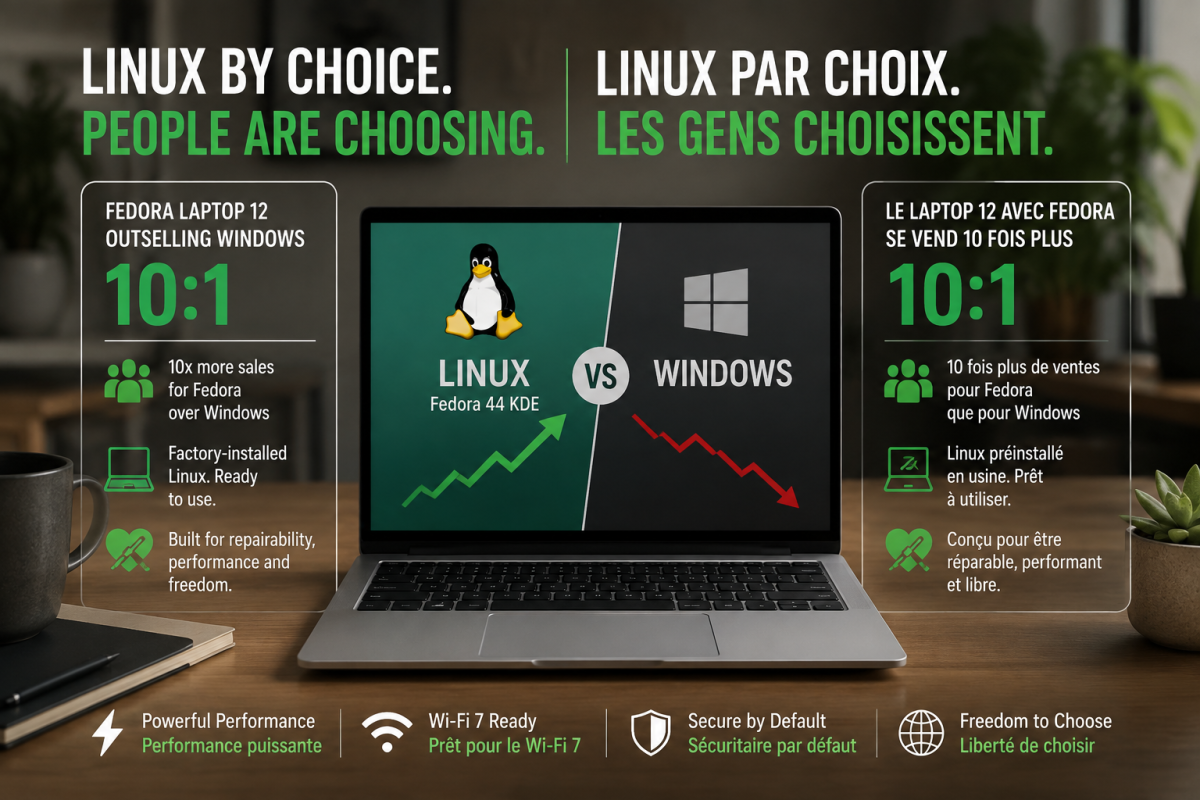
For years, Linux desktop adoption has faced a rather obvious problem: most consumers don't actually choose their operating system.
They choose a computer.
Walk into a typical electronics store or visit a major manufacturer's website and Windows is usually already installed. Linux users, meanwhile, generally have to buy the machine, replace the operating system themselves and sometimes research beforehand whether Wi-Fi, fingerprint readers, suspend, graphics and other hardware will work properly.
Framework is demonstrating what can happen when that equation changes.
The company says the Fedora Linux version of its newly refreshed Framework Laptop 12 is currently outselling the Windows version by more than 10 to 1 (Framework, 2026a).
That's an extraordinary ratio — but it needs some context.
Linux isn't an afterthought this time
Framework recently announced an updated Laptop 12 built around Intel's new Core Series 3 processors.
The 12.2-inch convertible remains Framework's smallest and most affordable laptop, but the new generation includes Thunderbolt 4, Wi-Fi 7, DDR5 memory and options including a backlit keyboard and fingerprint reader (Framework, 2026b).
The more interesting change, however, isn't inside the laptop.
It's the operating system.
Framework now sells a pre-built Laptop 12 with Fedora 44 KDE Plasma installed at the factory. The Fedora configuration starts at US$699, while Windows 11 remains available as an alternative (Framework, 2026b; The Verge, 2026).
That is important because Linux buyers aren't being asked to purchase a Windows computer and convert it into a Linux computer afterward.
They can simply buy a Linux computer.
And apparently they are.
Framework subsequently reported that its Fedora configuration was outselling its Windows configuration by more than 10 to 1 (Framework, 2026a).
Perhaps this shouldn't be surprising
Framework had already discovered something interesting about its customers.
Approximately 80% of existing Framework Laptop 12 users were running Linux, according to the company. That existing demand was part of the reasoning behind offering Fedora as a preinstalled option on the refreshed machine (The Verge, 2026).
So we shouldn't interpret the 10:1 figure as evidence that 90% of ordinary laptop buyers suddenly prefer Linux.
Framework's customer base is unusually technical, and the company's philosophy naturally attracts many of the same people who are interested in Linux and open-source software.
Framework builds computers around repairability, modularity and user control. Components can be replaced and upgraded, expansion ports can be changed, and replacement parts and documentation are readily available.
Those ideas overlap remarkably well with the values that have driven Linux and open source for decades.
Nevertheless, the sales ratio remains significant.
Hardware support matters
Another important part of Framework's approach is something Linux users have historically struggled with: manufacturers treating Linux compatibility as a responsibility rather than leaving the community to figure everything out.
Framework says it has worked with Linux communities to improve support for its hardware.
The company supplied pre-release Laptop 12 hardware to projects including CachyOS and Bazzite, allowing developers to prepare support before customers receive their machines. Framework has also worked on Linux support for its fingerprint hardware through libfprint (GamingOnLinux, 2026).
That changes the experience considerably.
Instead of:
Buy laptop → install Linux → discover what doesn't work → search forums → find workaround
the goal becomes:
Buy laptop → turn it on → use Linux.
That is how mainstream operating systems are supposed to work.
There is another factor: price
There's also a practical reason Fedora may be attractive.
The pre-built Fedora Laptop 12 starts at US$699, while the comparable Windows configuration carries the additional cost associated with Windows licensing. Framework's DIY Edition starts even lower, at US$549 for the new Core Series 3 generation, while remaining 13th-generation DIY models have been reduced to US$499 (Framework, 2026b).
For buyers who already want Linux, paying extra for a Windows licence they intend to erase makes very little sense.
For years this has been an odd reality of buying Linux-compatible computers: users sometimes effectively purchased Windows first simply because it came bundled with the hardware.
Framework is removing that step.
Linux isn't suddenly at 90% market share
The numbers need to remain in perspective.
A 10:1 sales advantage within Framework's Laptop 12 preorders does not mean Linux is outselling Windows across the PC industry.
It doesn't.
Framework occupies a relatively small and enthusiast-heavy part of the computer market, and its customers are considerably more likely than average consumers to understand Linux already.
But dismissing the result for that reason would also miss the point.
The interesting question isn't whether Linux suddenly defeated Windows.
It's this:
What happens when customers are actually given Linux and Windows as equally legitimate choices when they purchase a computer?
For this particular product and this particular audience, the answer is remarkable.
They're overwhelmingly choosing Linux.
Linux desktop adoption has a distribution problem
This may point toward one of the biggest barriers Linux has faced on the desktop.
The problem may not simply be convincing people to switch operating systems.
It may also be getting Linux onto computers before customers buy them.
Windows has enjoyed that advantage for decades. Consumers walk into stores, purchase PCs and take Windows home because that's what manufacturers installed.
Most never consciously selected Windows over Linux.
Linux has traditionally had to convince someone to replace an operating system that already came with their computer.
Framework is reversing that situation.
Fedora isn't hidden on a compatibility page or offered merely as instructions for advanced users. It's an actual factory-installed product.
That distinction matters.
A promising signal for the wider Linux ecosystem
Framework isn't alone in selling Linux hardware, of course. Several specialist manufacturers have done excellent work supporting Linux for years.
What makes developments like this particularly encouraging is the increasing normalization of Linux as a legitimate desktop option.
Hardware manufacturers working directly with distributions and upstream projects can solve problems that individual Linux users simply cannot.
Firmware can be tested.
Fingerprint readers can be supported.
Power management can be optimized.
Hardware can reach distribution developers before consumers receive it.
And Linux can arrive already installed.
When those things happen, Linux stops being something users have to make work on a laptop designed primarily for another operating system.
It becomes the operating system the laptop was designed to run.
The bigger lesson
Framework's 10:1 figure isn't proof that Windows is disappearing, nor should it be presented that way.
It's something more useful.
It's evidence that there is a meaningful market for computers sold with Linux when manufacturers actually offer them.
Perhaps the Linux desktop doesn't only need more users willing to install Linux.
Perhaps it needs more manufacturers willing to sell it.
Framework gave its customers that choice.
So far, those customers appear to be answering rather loudly.
Sources
Framework. (2026a). The Fedora version is outselling the Windows version by >10:1. X.
Framework. (2026b). Framework Laptop 12, now with Core Series 3.
Framework. (2026c). Framework Laptop 12.
Framework Laptop 12 product information
GamingOnLinux. (2026, August 18). Framework Laptop 12 gets Fedora KDE Linux on pre-builts, along with new Intel Core Series 3 processors.
The Verge. (2026, August 18). Framework gave its 12-inch laptop some hardware upgrades.
Comments (0)