


Looking Beyond the Purchase Price
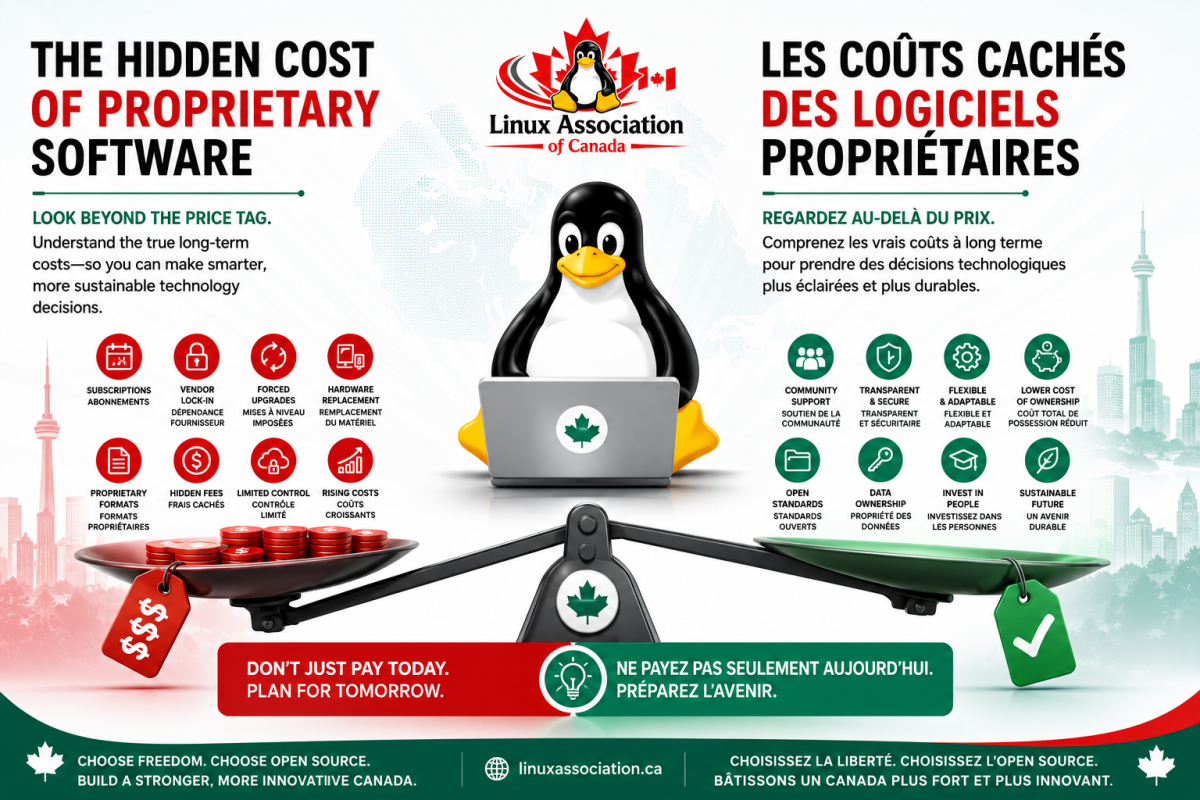
When organizations evaluate software, the first question is often, "How much does it cost?" While the purchase price or subscription fee is important, it tells only part of the story. The true cost of proprietary software extends far beyond the monthly invoice. Licensing restrictions, vendor lock-in, forced upgrades, and limited flexibility can significantly increase expenses over time.
For businesses, schools, non-profit organizations, and even government agencies, understanding these hidden costs is essential when making long-term technology decisions.
Subscription Costs Never Stop
Many commercial software products have moved away from one-time purchases to recurring subscription models. While monthly fees may appear affordable, they continue indefinitely.
Consider a company with 50 employees paying CAD $35 per user each month for productivity software. That amounts to:
- CAD $1,750 every month
- CAD $21,000 every year
- CAD $105,000 over five years
These figures often exclude additional services such as cloud storage, advanced security features, technical support, or premium functionality.
Recurring licensing costs become a permanent operating expense rather than a one-time investment.
Vendor Lock-In
One of the greatest hidden costs is becoming dependent on a single software vendor.
Once an organization has invested years into a proprietary platform, switching becomes increasingly difficult because of:
- Proprietary file formats
- Vendor-specific workflows
- Specialized staff training
- Custom integrations
- Data migration challenges
The longer an organization remains tied to one ecosystem, the more expensive it becomes to leave—even if better alternatives emerge.
Forced Upgrades
Organizations frequently discover that software they purchased only a few years ago is no longer supported.
This can lead to expensive upgrade cycles involving:
- New software licenses
- Hardware replacements
- Employee retraining
- Compatibility testing
- Downtime during migration
In many cases, the existing software still meets business needs, but vendor support policies require organizations to upgrade anyway.
Hardware Requirements
New software versions often demand newer hardware.
Perfectly functional computers may need replacement simply because the latest software requires more processing power, memory, or storage.
This creates unnecessary electronic waste while increasing IT budgets.
Many Linux distributions and open-source applications continue to perform well on hardware that proprietary operating systems may no longer support.
Limited Flexibility
With proprietary software, organizations generally have little control over:
- Feature roadmaps
- User interface changes
- Pricing decisions
- Licensing terms
- Product availability
A vendor may discontinue a product, change licensing conditions, or remove features with little notice.
Organizations must adapt—even when the changes do not align with their operational needs.
Data Ownership and Portability
Many proprietary cloud services store data in vendor-controlled environments.
Although organizations own their information, exporting it in a usable format or migrating to another platform may not always be straightforward.
Open standards and open-source solutions often provide greater flexibility, making it easier to retain control over valuable business data.
Security and Transparency
Proprietary software typically keeps its source code closed.
Users must rely on the vendor to identify and fix vulnerabilities without being able to independently verify how the software works.
Open-source software takes a different approach. Because the source code is publicly available, it can be reviewed by developers, researchers, universities, and security professionals worldwide. This transparency allows vulnerabilities to be identified and addressed openly, often leading to rapid improvements and increased trust.
Open source is not automatically more secure simply because its code is available, but transparency enables broader independent review and gives organizations greater insight into the software they rely on.
The Value of Open Source
Open-source software offers organizations a different approach.
Rather than paying primarily for software licenses, organizations can invest in:
- Professional support
- Staff training
- Security assessments
- Custom development
- Long-term strategic planning
This shifts spending from recurring licensing fees toward services that directly improve organizational capability and resilience.
Making an Informed Decision
Choosing proprietary software is not inherently the wrong decision. In many situations, commercial products may offer features or support that best meet an organization's requirements.
However, every technology decision should consider the total cost of ownership, not simply the initial purchase price. Organizations that evaluate licensing costs, upgrade cycles, hardware requirements, vendor dependency, data portability, and long-term flexibility are better positioned to make informed decisions.
Open-source software deserves a place in that evaluation. For many organizations, it can provide comparable functionality while offering greater control, flexibility, and long-term value.
How the Linux Association of Canada Can Help
Every organization has unique operational requirements, and there is no one-size-fits-all technology solution.
The Linux Association of Canada helps businesses, educational institutions, non-profit organizations, and public sector organizations explore open-source alternatives through independent guidance, training, workshops, and advisory services. Whether you are considering a gradual migration, evaluating Linux for specific workloads, or simply looking to better understand your options, our goal is to provide practical information that supports informed decision-making.
Technology decisions should be based on your organization's needs—not on habit or vendor pressure. By understanding the hidden costs of proprietary software and comparing them with open-source alternatives, organizations can build more sustainable, flexible, and resilient technology strategies for the future.
Comments (0)